Custom application build
Your business rules implemented in Laravel, with a clear domain model rather than logic scattered across controllers.
Laravel applications, APIs and portals — built for businesses whose workflow does not fit any off-the-shelf tool, and maintained so they still work in three years.
Most custom software projects start the same way: a spreadsheet that three people maintain, a process held together by email, and a rule that only one person remembers. It works until the business grows, and then it quietly becomes the constraint on everything.
Laravel is a good answer to that problem. It is a mature PHP framework with the unglamorous things already solved — authentication, permissions, queues, scheduled jobs, notifications, file handling, database migrations. That means the budget goes into your actual business rules rather than into rebuilding the basics.
It is also a practical choice for the long run. PHP developers are not hard to find, hosting is inexpensive and well understood, and a Laravel application written to the framework’s conventions can be picked up by another team without an archaeology project. For a business that will own this software for years, that matters more than a faster benchmark.
Custom software is expensive and sometimes unavoidable. These are the signals that it is time.
Book a process reviewThree kinds of Laravel work that come up again and again.

Quotes, jobs, stock, approvals, scheduling — the processes your team runs manually today, turned into software with permissions, an audit trail and no risk of somebody sorting one column and not the rest.
Client and partner logins where people can see their orders, documents, invoices or progress without emailing your team to ask. Support volume tends to fall the week it launches.

A Laravel API behind a React front end or a mobile app, and integrations that keep your CRM, accounting, ERP and store in sync so nobody retypes an order.
The parts of a custom application that decide whether it survives its first year.
Your business rules implemented in Laravel, with a clear domain model rather than logic scattered across controllers.
Logins, permissions, teams and audit trails, using the framework’s tested foundations.
Long tasks, imports, exports and reports running in the background instead of blocking a page.
A schema that fits how the business actually works, versioned so changes are repeatable.
Automated tests on the expensive paths, error tracking and alerts once it is live.
Written explanations of the decisions, so the next developer is not guessing.
Custom software is worth it when the process is your advantage, not when it is just unusual.
Talk through your processSix stages, with working software in front of you early rather than at the end.
We map how the work actually happens today, including the exceptions, because that is where custom software usually fails.
What gets built first, what waits, how the data is modelled, and a fixed estimate for phase one.
Screens and flows for the core journeys, designed for the people who will use them all day.
One usable workflow at a time on staging, so feedback arrives while it is still cheap.
Existing records imported and checked, with automated tests on the paths that matter.
Go-live, monitoring, training, and a support period while the team settles in.
A first phase usually runs 8–16 weeks. We deliberately keep phase one small enough to be used, then extend it.
| Stage | Typical time | What you receive |
|---|---|---|
| Process discovery | 1–2 weeks | Process map, scope, phased plan, fixed estimate |
| Design | 1–2 weeks | Screens and flows for the core journeys |
| Core build | 4–8 weeks | Working slices on staging, reviewed as they land |
| Integrations & migration | 2–3 weeks | Connected systems, imported data, test coverage |
| Launch & settling in | 1–2 weeks | Go-live, training, monitoring, early fixes |
Where a custom backend is usually the right call.
Quoting, job tracking, inventory, approvals and scheduling.
Self-service access to orders, documents, invoices and status.
Availability, resources, reminders and payments in one flow.
A backend for a React front end, a mobile app or a partner integration.
Multi-vendor platforms with commissions, payouts and vendor dashboards.
Replacing an ageing custom system without losing the rules buried inside it.
Laravel with the pieces around it that production software needs.
The application, written to the framework’s conventions.
Relational data, caching and queues.
APIs for front ends, apps and partner systems.
Automated deployment, error tracking and uptime alerts.
Custom applications are quoted per phase after discovery. If an off-the-shelf tool would do the job for a fraction of the price, we will tell you which one — that conversation is cheaper for you than a build you did not need.
Get your estimate NeuralSync
High-volume business logic, CRM updates and data pipelines were running on manual operations work — slow, expensive and easy to get wrong.
Read case study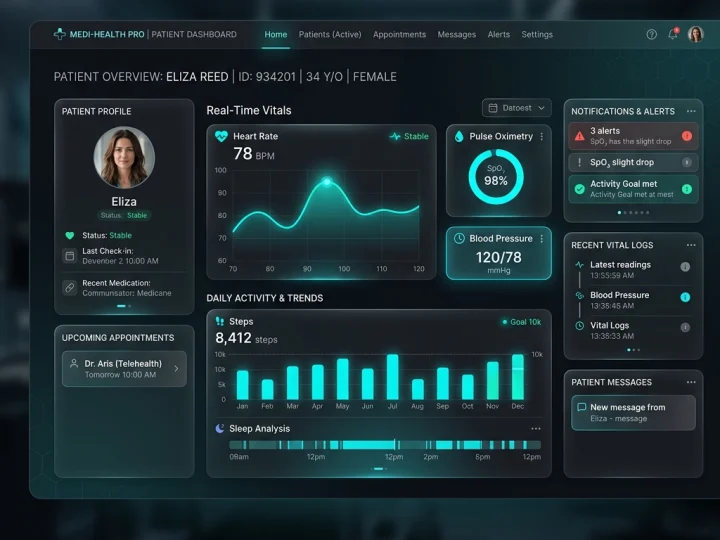 Pulse Telehealth
Clinicians were juggling disconnected tools for patient vitals, appointments and notes — under rules that leave no room for improvisation.
Read case studyWeb applications, dashboards and high-performance sites built in React and Next.js — typed, tested and structured so the next developer can read them.
Learn moreWorkflow automation and AI integrations that remove repetitive manual work — built on the systems you already run, with a human in the loop wherever it matters.
Learn moreCustom WooCommerce stores on WordPress — your content and your shop in one place, with full control over the checkout, the data and the costs.
Learn moreUpdates, backups, security monitoring, uptime checks and the small changes you need every month — handled by the team that builds websites for a living, not a support queue.
Learn moreWhat businesses ask before commissioning custom software.
Still have a question? Ask us on WhatsAppTell us what you're trying to build, improve or automate.
Start your project



Trusted by 50+ founders & tech leaders worldwide