REST & GraphQL APIs
Versioned, documented APIs with authentication, validation and sensible error handling.
APIs, real-time features and integration services in Node.js — typed, tested and instrumented, so they keep working when traffic arrives.

Node.js is at its best when a service spends most of its time waiting — on a database, an API, a file, another service. Because it handles that waiting without tying up a thread for each request, one modest server can hold a very large number of connections at the same time. That is why it is a natural fit for APIs, webhooks, streaming and anything real-time.
It is a poor fit for heavy computation in the request path. Long, CPU-bound work blocks the event loop and everything else queues behind it. The fix is not to abandon Node but to move that work into a queue or a separate worker, which is one of the first architectural decisions we make on a project.
The other reason businesses choose it is that the whole stack speaks one language. If your front end is React or Next.js, a Node backend means shared types, shared validation and one set of tooling. Fewer context switches for the team, and fewer places for the same rule to be implemented twice, slightly differently.
Three jobs Node.js does better than most alternatives.
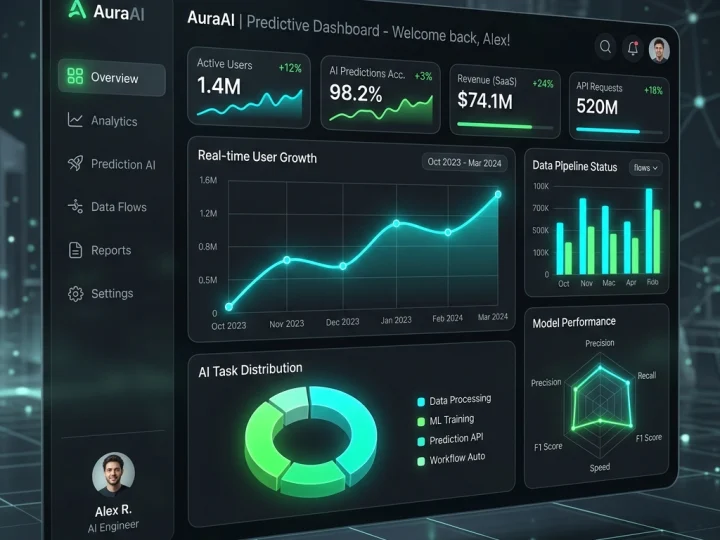
REST or GraphQL APIs serving a web app, a mobile app and partner systems from one place, with authentication, rate limiting, validation and versioning built in from the start rather than bolted on later.

Live dashboards, notifications, chat, collaborative editing and order tracking over WebSockets or server-sent events — the pattern Node handles most comfortably.

Webhooks, scheduled syncs and queued jobs connecting your store, CRM, ERP and accounting. Written with retries, idempotency and dead-letter handling, because every third-party API fails eventually.
Backend work that has to be reliable rather than clever.
Versioned, documented APIs with authentication, validation and sensible error handling.
WebSocket and event-driven features for live data, notifications and collaboration.
Long tasks, imports and exports moved off the request path, with retries and monitoring.
Middleware that keeps your store, CRM, ERP and accounting in sync without manual work.
Sessions or tokens, roles, API keys and audit logging done to current practice.
Structured logs, error tracking, health checks and tests on the paths that would cost you money.
A service that has never been load tested is a service that has never really been tested.
Talk about your backendWhere a Node service is usually the right tool.
One language across the stack, with shared types between front and back.
A single API serving iOS, Android and web clients.
Custom logic in front of Shopify or WooCommerce, such as pricing or fulfilment rules.
Small services split by responsibility, with clear contracts between them.
Scheduled imports, transformations and exports that run unattended.
Event-driven endpoints where paying per request beats running a server.
Well-supported choices, not whatever was released last month.
Typed services with predictable structure.
Chosen per project: light and direct, or structured and opinionated.
Relational data, caching, queues and rate limiting.
Reproducible environments and automated deployment.
Five stages, with the API contract agreed before anyone builds against it.
What the service must do, expected load, which systems it talks to, and what happens when they fail. Scope and a fixed estimate follow.
Endpoints, payloads and error shapes agreed and documented first, so front-end work can start in parallel.
Services, data model, authentication and queues built and deployed to staging in slices.
Third-party systems connected, with retries, rate limits, logging and load testing.
Deployment, monitoring, alerting, documentation and a walkthrough for whoever runs it next.
A focused service runs 6–14 weeks. A single integration is faster; a platform with several services takes longer.
| Stage | Typical time | What you receive |
|---|---|---|
| Discovery & scope | 1 week | Requirements, architecture note, fixed estimate |
| API contract | 3–5 days | Documented endpoints and payloads |
| Core build | 3–6 weeks | Working services on staging, reviewed as they land |
| Integrations & hardening | 1–3 weeks | Connected systems, retries, load tests, monitoring |
| Launch & handover | 1 week | Deployment, alerting, documentation, training |
Backend work is quoted after discovery, because load, integrations and reliability requirements drive the number far more than the endpoint count does.
Get your estimateThe symptoms that usually bring an existing Node service to us.
Ask for a backend review CryptoFlow
Active traders needed institutional-grade speed and cross-chain liquidity in one terminal, on a web app that stays readable while every number on screen keeps moving.
Read case study NeuralSync
High-volume business logic, CRM updates and data pipelines were running on manual operations work — slow, expensive and easy to get wrong.
Read case studyWeb applications, dashboards and high-performance sites built in React and Next.js — typed, tested and structured so the next developer can read them.
Learn moreLaravel applications, APIs and portals — built for businesses whose workflow does not fit any off-the-shelf tool, and maintained so they still work in three years.
Learn moreWorkflow automation and AI integrations that remove repetitive manual work — built on the systems you already run, with a human in the loop wherever it matters.
Learn moreCore Web Vitals, page speed and server tuning for WordPress, WooCommerce and Shopify — measured on mid-range devices and real connections, not on a developer’s laptop.
Learn moreWhat clients ask before choosing a Node backend.
Still have a question? Ask us on WhatsAppTell us what you're trying to build, improve or automate.
Start your project



Trusted by 50+ founders & tech leaders worldwide